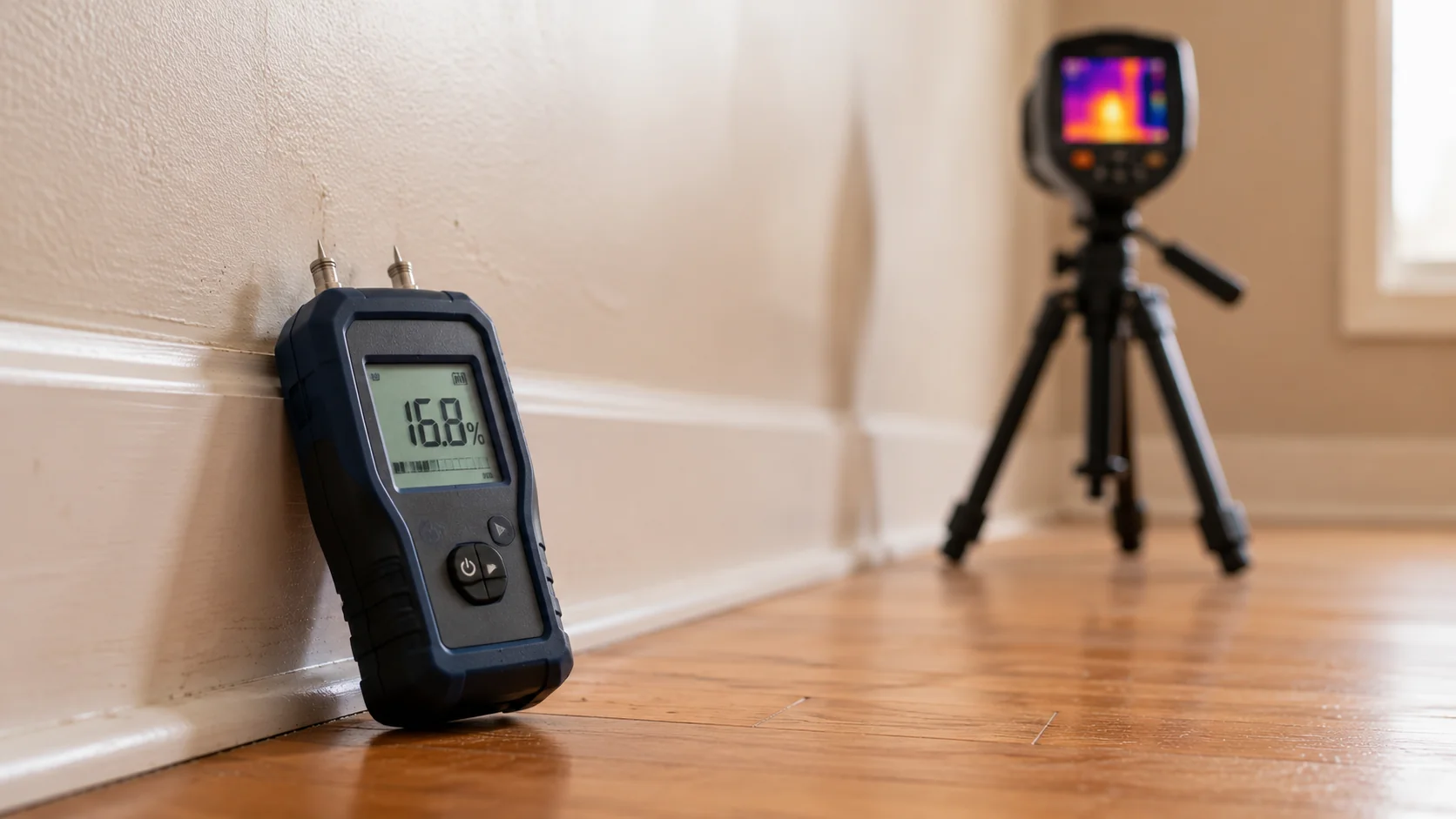
A real inspection is 90 to 120 minutes. Two technicians (sometimes one) arrive in unmarked work vehicles. We don't pitch on site. We measure, sample, and leave. The quote shows up in your inbox within 48 hours of the lab results.
Here's exactly what those 90 to 120 minutes look like.
Before we arrive
Two things from you:
- Empty the cabinet, attic hatch, crawl-space hatch, or wherever the suspect area is. Save us 10 minutes of moving boxes.
- Crate or close-off the pets. Not because they're a problem - because the equipment makes startling noises and we don't want to spook them.
We'll have already confirmed the appointment slot by text or email. We arrive within a 15-minute window of the scheduled time.
The first 10 minutes - intake conversation
We sit at the kitchen table with you. The questions we ask, in order:
- What did you see, smell, or notice? Verbatim, in your words.
- When did you first notice it? Helps us scope whether this is days, weeks, months, or years.
- Any recent water events? Leaks, floods, ice dam, appliance failure, roof issue, sewer backup, slow plumbing drip you've been meaning to fix.
- Anyone in the household with respiratory or allergic symptoms? Including pets. We're not doctors but the symptoms inform what we sample.
- What have you already tried? Cleaning, painting, scrubbing, ventilating, dehumidifying. Tells us what's been disturbed and where.
- Any insurance involvement? Influences how we document.
You don't need to have answers to everything. "I don't know" is a fine answer to most of these.
The next 60 to 80 minutes - walkthrough
We carry three tools and a clipboard:
- Calibrated pin-and-pinless moisture meter. Reads moisture content of wall, floor, ceiling materials. Pinless slides over the surface; pin probes into questionable areas without leaving a visible mark on baseboards or trim.
- Thermal imaging camera. Reveals hidden cold spots that often correspond to wet areas behind walls. Doesn't see mold; sees the temperature signature of evaporation or trapped moisture.
- Borescope (sometimes). A 7mm flexible camera for peering into wall cavities through outlet boxes or small inspection holes. Used only when readings suggest hidden contamination.
The route we walk:
- Suspect area first. The room or feature you flagged. Moisture readings on every wall surface, ceiling, floor edge, and any visible discoloration.
- Adjacent spaces. Above, below, and either side. Moisture migrates through framing; you might see a stain in the master closet that originated above the laundry.
- HVAC system. Quick look at the return air opening + accessible supply registers + a glance at the air handler. Most residential systems we don't disassemble; we look at what's accessible.
- Basement, crawl, attic. Whichever are present. The crawl is the slowest because we crawl. Bring a flashlight if you want to follow along.
- Exterior. Gutter integrity, downspout extensions, grading away from the foundation, weatherproofing at penetrations. The moisture source is often outside.
Throughout, we take photos. Roughly 30 to 60 per visit. They go into a shared folder you can access on your phone within 24 hours.
The last 10 minutes - sampling
If the walkthrough indicates testing is warranted, we collect samples. The options, in order of how often we use them:
- Indoor air sample. Standard 5-minute draw across a spore-trap cassette in the room of concern. We collect at chest height in the room center.
- Outdoor control air sample. Same 5-minute draw, taken just outside the building during the same window. This is the comparison baseline.
- Surface tape lift. A small adhesive square pressed to a discolored spot. Lifts the spores for direct microscopic identification.
- Bulk sample. A small piece of affected material (drywall corner, insulation tuft) bagged and sent to the lab.
- ERMI dust sample. Optional. Used for sensitized individuals working with a physician.
If the walkthrough indicates testing is NOT warranted - which happens more often than people expect - we say so. You don't pay for samples we don't think you need.
Before we leave
- Verbal preliminary read. What we observed, what we suspect, what we're uncertain about, what to do in the meantime. Specific, not vague.
- What happens next. Lab turnaround (typically 2 to 4 business days), what you'll get in writing, who to contact if your situation changes before the report.
- Any urgent moves you should make this week. Usually drying recommendations, sometimes "stop using that bathroom until the leak's fixed."
- No commitment to anything. You haven't signed a remediation contract. You haven't agreed to a price. You can take our report to two other contractors for comparison, and we'll tell you that explicitly.
What we don't do on site
This is the part the brand exists to stand against. We do NOT:
- Pitch a remediation in your kitchen. There's no closing pressure, no "today-only discount," no upsell. The scope and quote come in writing afterwards.
- Try to scare you. If something is concerning, we say what it is, what the typical outcome looks like, and what your options are. Plain English.
- Recommend a remediation that the lab doesn't support. If your spore counts come back at outdoor baseline, we tell you that and you don't need us.
- Use unmarked or generic "we'll write it up later" pricing. Our scope is line-item Xactimate format your insurance can read.
- Run the inspection by phone or by photo only if a real visit is warranted. If a photo is enough, that's /photo-check and it's free.
After we leave
Within 48 hours of lab turnaround, you get:
- Written report. PDF, brand-stamped, with photos, moisture readings, sample results, and our recommendation.
- The lab's report. Direct from the lab, on their letterhead, not ours. So you can see we didn't filter or summarize.
- If remediation is warranted, a line-item scope. Xactimate format, line by line, with your insurance adjuster's name on it if you've given us that.
- If remediation is NOT warranted, that's the report. Sometimes the right answer is "your spore counts match outdoor, here's a small moisture-source fix, you don't need us."
Cost of the inspection itself: free for residential single-room concerns under 90 minutes on site. Larger jobs (whole-home, commercial, pre-purchase inspections requiring 2+ hours) run $250 to $450 quoted in advance.
What if I'm not sure I want a full visit yet
The photo upload is free, takes 2 minutes, and gets you a real human assessment within 2 business hours. About a third of those resolve without needing a visit at all.
If you'd like a 20-minute phone consult before deciding, book one and select "phone consult" as the type. No charge.
What to ask any inspector before they show up
If you're inspecting us OR a competitor:
- "Are you IICRC certified, in what specifically (AMRT, WRT, HST)?"
- "Do you use a third-party lab, or do you run your own?"
- "Do you charge for the visit if remediation isn't warranted?"
- "Will I get the lab's report directly, or only your summary?"
- "If you recommend remediation, are you the same company that would do the work?"
The honest answers are: yes / third-party, named / no for standard residential / yes you get both / yes but you can take our scope to other contractors. If any answer differs, dig in.